Jasperland
About Archive Photos Also on Micro.blog
  • Future Blooms

    This weekend we visited a dear friend who I am connected with because she and my mother-in-law befriended each other in their early twenties. We’ve stayed with our friend many times—she’s a great and generous host—and one of the incredible things about staying with her is that she has lived in her same beautiful house for my partner’s entire life. Each visit is also a return.

    On this visit, I took my child out to the back yard and showed him the orchids. These orchids were given to our friend as a housewarming present by my child’s great-grandmother, half a century ago.

    A photo of a delicate orchid blossoms emerging amidst green leaves

    What are we planting today that might bloom and keep blooming, decades from now?

    → 4:25 PM, Feb 4
    Also on Bluesky
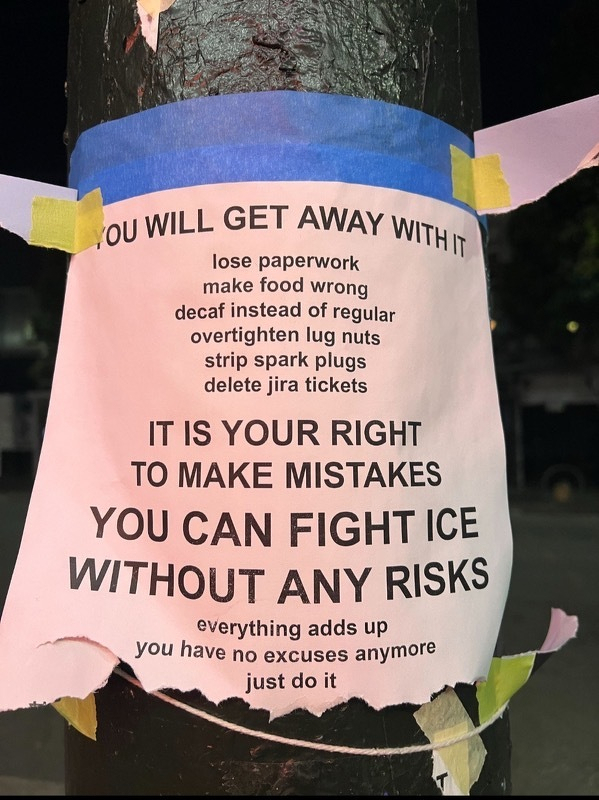
  • Someone put these posters up in San Francisco:

    A photo of a poster reading YOU WILL GET AWAY WITH IT
lose paperwork
make food wrong
decaf instead of regular
overtighten lug nuts
strip spark plugs
delete jira tickets
IT IS YOUR RIGHT
TO MAKE MISTAKES
YOU CAN FIGHT ICE
WITHOUT ANY RISKS
everything adds up
you have no excuses anymore
just do it

    → 4:24 PM, Feb 4
    Also on Bluesky
  • Interviewing the Inventor of “Environmental Grief”

    In these days, I think it’s important not to look away from death, grief, and transformation. So I was delighted to get to engage in a wide-ranging podcast interview with Kriss Kevorkian, a thanatologist who holds the distinction of having invented the term “Environmental Grief.” I wrote in my blurb for the episode that “Kriss talks about thanatology, her own work on behalf of the Southern Resident Orcas in the Salish Sea, and how we can harness environmental grief to act on behalf of the non-human world.” A rich vein of thought, and one we don’t discuss enough.

    → 4:23 PM, Feb 4
    Also on Bluesky
  • The Pineapple Vinegar / Sauerkraut Report

    When you ferment, you want things to get funky, but not too funky. Since last time we checked in on the sauerkraut and the pineapple vinegar, each had a moment of seeming like all was lost.

    With the sauerkraut, one day I checked on it and found that the water level had fallen far enough that a layer of cabbage was no longer submerged. And this layer was developing a suspicious white mold. Oh no! I carefully removed the weights and then even more carefully removed all of the bad cabbage, erring hard on the side of removing too much. Then I carefully cleaned the sides of the crock with paper towels, scrubbed the weights with soap and hot water, and added more brine. I packed it all up and set it back on the shelf, worried that the mold would re-appear and I would have to discard the whole batch. But the mold never came back, and another week later I tasted the remaining kraut. No off flavors, no sense that anything had gone wrong. Instead, just deliciously sour sauerkraut.

    With the vinegar, I strained out the chunks of pineapple skin after a week, leaving a cloudy liquid. It first turned to wine (it tasted sharp and wild), then started developing lacy white foam on top. I worried this meant it was somehow infected, so I carefully skimmed it all out. Then I realized: doesn’t vinegar need to grow a “mother” to really ferment? So I stopped skimming, and sure enough it grew a leathery little layer of bacteria and yeast on top—and shortly thereafter it started tasting like—you guessed it—vinegar. Strongly pineapple-scented, wonderfully funky (in a good way) vinegar.

    A photo of a bunch of mismatched jars, some red and labeled KRAUT and others yellowish, labeled VINAIGRE DE PIÑA

    This was my first time making my own vinegar. I found it empowering, getting to track the process from beginning to end. Previously, vinegar was just something I found in the condiment aisle at the grocery store. Now I know how it’s made. The simple mystery (where does vinegar come from?) has been replaced by deeper mysteries (what’s really happening in there? what makes great vinegar great? what else can I transform like this?).

    → 4:23 PM, Feb 4
    Also on Bluesky
  • Mass Protagonism

    Related: an account of evolving tactics in “Fighting for the future in occupied Minneapolis” by Pranay Somayajula. Loved this bit in particular:

    My comrades and I often make reference to the idea of “developing mass protagonism,” a concept with roots in Latin American Marxist thought that expresses an understanding that successful organizing means helping people see themselves not merely as passive subjects of history, but as active agents with the collective power to bring about revolutionary transformation. I have become increasingly convinced that rather than asking people what radicalized them — a familiar question for anyone who has spent time in left activist circles — a better query would be: what protagonized you? Over the last several weeks, whether or not they realize it yet, thousands of people across Minnesota have found an answer to that question.

    One of the great tricks of late-stage capitalism is to convince the mass of us humans that we are powerless in the face of the machinery of state power and capital. But in fact it is nothing more than our collective decision to believe in authority and numbers in a ledger that allows these systems to persevere! As Ursula K. Le Guin famously said,

    Hard times are coming, when we’ll be wanting the voices of writers who can see alternatives to how we live now, can see through our fear-stricken society and its obsessive technologies to other ways of being, and even imagine real grounds for hope. We’ll need writers who can remember freedom—poets, visionaries—realists of a larger reality… We live in capitalism, its power seems inescapable—but then, so did the divine right of kings. Any human power can be resisted and changed by human beings. Resistance and change often begin in art. Very often in our art, the art of words.

    → 4:21 PM, Feb 4
    Also on Bluesky
  • Community Is Wherever People Care

    Another way I like to feel connected to other people is to root for a sports team. Being a fan means sometimes giving yourself over to ecstatic celebration, other times sharing in a collective sorrow. If you do it right, you care inordinately about a game defined by arbitrary rules, played by people you’ll likely never meet. The key is doing it together.

    As a fan of the Golden State Warriors, the past decade has given me plenty of sports nirvana (four rings!) but also some gutting setbacks (Durant’s Achilles tear, Klay’s ACL tear, Draymond’s nut-shot and punch, James Wiseman, etc.). I’ve shared all of these ups and downs with my brother, with my partner, and also with the writers and commenters on the many fan-blogs I follow. Whenever a big piece of Warriors news comes out, I’m immediately curious how other people reacted, what they thought, how they felt.

    Two weeks ago, our second superstar, Jimmy Butler, (for whom I was ecstatic that the Warriors traded) tore his ACL. This has mostly sunk our chances to make the playoffs, let alone win a championship, this season. And with Greatest Warrior of All Time Steph Curry now 37 years old, it may mean the end of what has been a glorious run.

    To process this, I of course turned to my two favorite blogs: Golden State of Mind and Dub Nation HQ. There was plenty of openhearted, thoughtful writing in both the blog posts and the comments. I especially appreciated this meditation by a guest blogger named Riley Gaucher. Gaucher writes openly about their own tendency to be a fair-weather fan, riveted when the team is winning and tuning out when they suck. (Honestly, same.) This leads them to some deep places:

    Mortality. For me, watching athletes get injured always makes me confront my mortality. If this whimsical escapism with wholly artificial meaning can be threatened by reality, what does that say about my real-world life? And what is the point of giving so much of my time and energy and hope to something that hurts so bad and now seems so hopeless? Without any realistic chance to compete, how do I keep the same passion for this team and sport? Will I be able to defeat my fair-weather tendencies or will I let the Warriors be a smaller part of my life now?

    A week after Butler’s injury, the Warriors’ plans were again thrown in disarray—but this time it was because of our increasingly fascist moment. They were scheduled to play an away game against the Minnesota Timberwolves the same day that federal agents murdered Alex Pretti in Minneapolis. The league ended up postponing the game by a day.

    This was a small disruption, in the scheme of things. But not knowing what else to do, I checked the sports blogs. And I found that the post about the postponement was offering a vital space for the site’s regular commenters to share their grief and fear.

    One comment in particular struck me as one of the smartest, and scariest, warnings I’ve seen about the wave of authoritarianism that’s currently breaking against our political system and communities and neighbors’ bodies. It came from the commenter ScottWarrior, whose comments I’m very familiar with. ScottWarrior posts on Golden State of Mind after almost every game. He’s opinionated, informed, and verbose. He often engages in back-and-forths with other commenters, engaging in spirited conversations about which players deserve more or less playing time, coaching decisions, moments that swung the game, etc. I always appreciate reading what he has to say. So I was interested to know what he would say here.

    The whole comment is worth reading. It offers the perspective of an emigré from an authoritarian state—Belarus—discussing how that regime operates and answering the question “How does it work so that the people of Belarus can’t get rid of him for so long?” The part that most interested me was about how the security services work:

    At 18, the male half ends up going to the army instead. All male population has a compulsory 2 year army service. What do they do after that? The options are going back home, stay in the army in some capacity or get a job with police. Police and army are the top priorities by the dictator. He builds free accommodation for them in the cities (get a job - get a flat in the capital), pays top salaries, have their retirement age at 45 y.o., etc. No special skills is needed and any village boy can have an above average life in a city. But the most important thing is that no matter what the policemen do, the dictator never throws them under the bus. They kill opposition leaders on his behalf, kill protesters on streets or torture thousands of them in prisons, but they know one thing for sure - as long as he is in power, they won’t be ever brought to justice (the court is under his control too, obviously). Per capita, we have 10 times more police than the neighbouring Poland. Dictatorship always needs armed protection by loyal forces.

    Protests have no chance because it is always unarmed people, a lot of them, against armed police and sometimes army. For the protest to have a chance, one needs at least a small part of armed people, police or army, to change sides or at least refuse shooting people, but it doesn’t happen. It doesn’t happen because the police is part of the regime. You overthrow the regime and 90% of them would lose their jobs. They know it and they also know that they don’t know how to do anything else to get another job. For some, mostly the top officers, the situation is even worse as they would get to prison for what they have previously done as part of the system.

    This is bleak stuff, and I feel real sorrow especially for the people of Belarus. It also feels crazy to find some of the more coherent political analysis going down in the comments of a basketball fan blog. But then why would that be so crazy? Community is where you find it, and we can find our best comrades in our regular haunts.

    → 4:20 PM, Feb 4
    Also on Bluesky
  • Exuberant Moshing

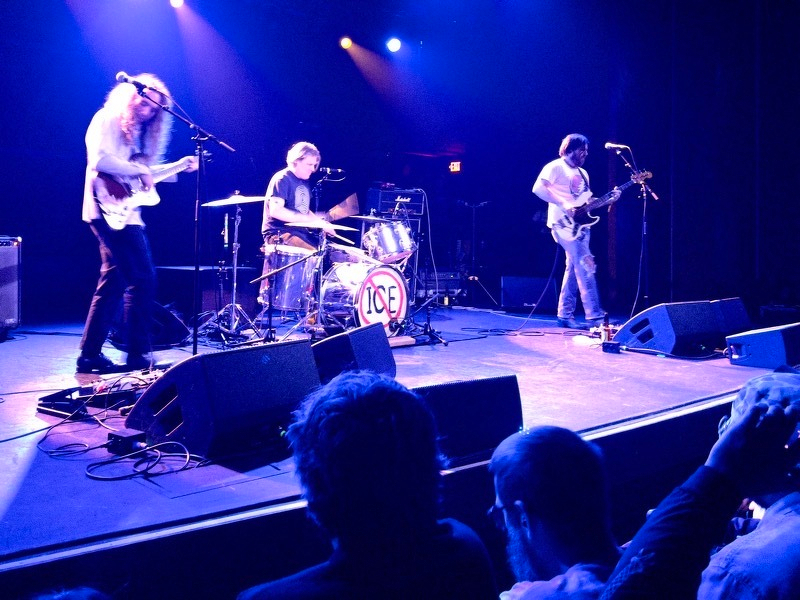
    We went to see Fuzz play a rare hometown show at the Bellwether. In response to their technically hypercompetent, psychedelia-inflected punk stylings, the crowd exuberantly moshed and crowdsurfed. With everything happening out in the world, it felt good to be out with everyone else, earplugs in, rubbing shoulders together, all moving with the music.

    (Also, check out Ty Segall’s kick drum. More of this, please!)

    A photo of the band fuzz playing on stage. The drummer's kick drum says "ICE"with a red line crossing it out.
    → 4:19 PM, Feb 4
    Also on Bluesky
  • F.L.O.W.

    Lisa has been wearing this t-shirt for a decade now:

    A photo of a woman wearing a t-shirt that says "Feminist Library on Wheels" and shows a line drawing of a little cart that opens up to be tiny bookshelves.

    Over the weekend, the kid asked what it was a picture of, and we both realized that we didn’t know. Was it the silhouette of a real portable library or was it just a fantasy of one, à la Moose’s Book Bus? Lisa had been following Feminist Library on Wheels on Instagram for many years but had never seen a picture of anything that looked like this glorious, bike-core contraption. So we scrolled back and back and back—and found the sacred machine!

    A filtered Instagram photo of the library on wheels in front of the Silver Lake Reservoir. Someone lounges on a blanket nearby.
    → 1:02 AM, Jan 21
  • A 500-Year-Old Miniature Book of Hours

    Vincent Poturica writes in to share his own encounter with a tiny book, which happened to coincide with reading my essay on “The Zen of Tiny Books”:

    I’m in NYC and, yesterday at The Cloisters, took a couple pics of an astounding, tiny prayer book (from a Dutch Middle Age artist) that moved me to tears.

    A photo of a tiny illuminated manuscript

    This “diminutive Book of Hours” was made by Simon Bening circa 1530-1535. It measures about 2½ by 2 inches. The catalog text goes hard on its enchanting tininess:

    It was a reminder of the omnipresence of God, meant to be attached to its owner, or stored with precious possessions. There is a special magic achieved by Bening’s exceptional skill at creating a miniature world. The miniatures follow standard convention, but Bening consistently tweaks the presentation, making this manuscript exceptionally poignant and affecting.

    I wish I was in New York…I’d go visit this book that so moved Vincent!

    → 12:59 AM, Jan 21
  • Someone put these posters up around the neighborhood.

    A photo of a poster taped to the side of a wall. It reads "HEY THERE
ICE
GET TF
OUT
OF
LA
WHAT ICE IS DOING RN
• SHOOTING AT CARS • HIDING IN MASKS • JUST BLINDED A • 
PROTESTER DOWN IN SANTA ANA • ABDUCTING FRUIT GUYS • GESTAPO TACTICS •THEY KIDNAP /
DISAPPEAR OUR NEIGHBORS"

    → 12:58 AM, Jan 21
  • I found Hearn’s piece through Today in Tabs, where I also found a link to some free anti-ICE posters that I printed out onto vinyl sticker paper and cut out. I’m not sure exactly what I’m going to do with them.

    An array of six stickers reading "WE BEAT EM BEFORE... WE'LL BEAT EM AGAIN" and showing a Nazi getting bayonetted and an ICE agent getting filmed on camera.
    → 12:56 AM, Jan 21
    Also on Bluesky
  • A Voice from Minneapolis

    The most hopeful thing I read this week was an account from a Minneapolis resident, Winston Hearn, of the mutual aid networks and bravery and love breaking out across the Twin Cities, despite it all. I loved this description of patrols and attempts to disrupt ICE (and I watched the linked video at least five times):

    There are patrols in every neighborhood, at every school, watching for the unmarked cars that suggest the paramilitary terrorists are coming. Those patrols are supported by people who can check tags, relay information, track in real time through trusted networks. When ICE agents get brave enough to step out of their cars, the community swarms to make their jobs difficult. Here is a video with no violence that shows just how this works. People materialize to witness, to confuse, to chase off. To protect everyone that they can.

    → 12:55 AM, Jan 21
  • A black-and-white photograph of a cactus wearing sunglasses
    → 12:54 AM, Jan 21
  • Police State Glossary

    Here are two terms that help me as I try to make sense of The National Political Scene™ in this dark hour:

    I. Diversity of Tactics

    This concept says that we are all in charge of our own actions and those tactics that we are comfortable with, but we should as much as we can refrain from criticizing the tactics of those with whom we share concerns and goals. For instance, I personally am deeply committed to nonviolence and will not engage in property destruction—but I refuse to spend my voice and energy denouncing the protesters who burned down a police substation in Minneapolis in the wake of George Floyd’s murder. Here’s Malcolm X (via Wikipedia) explaining the reasoning behind diversity of tactics:

    Our people have made the mistake of confusing the methods with the objectives. As long as we agree on objectives, we should never fall out with each other just because we believe in different methods or tactics or strategy to reach a common goal.

    Imagine if Martin Luther King, Jr. had spent significant time criticizing Malcolm X and the Black Panthers because of their more militant tactics. He would have played right into the hands of the racist, segregationist right. And without more militant actors making King’s nonviolence seem reasonable and like a decent compromise, we might never have had the Civil Rights Acts.

    Now look at this headline and framing from the New York Times:

    A screenshot from the New York Times front page reading, "Abolish ICE? It's a Slogan
Some Democratic Critics of
ICE Would Abolish.
Some Democrats worry that calls
to eliminate Immigration and
Customs Enforcement will distract
from efforts to rein in the agency.
5 MIN READ"

    This kind of hand-wringing and scolding of the left plays directly into the hands of the fascists! How in the ever-loving world do you think centrist Democrats might have the chance “to rein in the agency” if not by having this position seem like the reasonable, compromise in contrast to the vehemence and moral clarity of the “Abolish ICE” crowd. This compulsive criticism of the left is itself a bad tactic, and one that takes pressure off of the very agency (ICE) that these “Democratic Critics” are supposedly critical of.

    David Graeber has a wonderful explanation the necessity of embracing a diversity of tactics—and the danger of trying to police others’ tactics—in his short essay “Concerning the violent peace-police”:

    Successful movements have understood that it’s absolutely essential not to fall into the trap set out by the authorities and spend one’s time condemning and attempting to police other activists. One makes one’s own principles clear. One expresses what solidarity one can with others who share the same struggle, and if one cannot, tries one’s best to ignore or avoid them, but above all, one keeps the focus on the actual source of violence, without doing or saying anything that might seem to justify that violence because of tactical disagreements you have with fellow activists.

    II. Police Riot

    This term describes a confrontation between police and civilians in which the police are the ones inciting, escalating, and sustaining violence. I learned this term during the George Floyd protests in 2020, and I wrote about it then:

    [P]olice have committed many of the signal violent acts of the last week-and-a-half. Perhaps nowhere has this been clearer than when military police gassed and assault[ed] peaceful protesters in D.C.’s Lafayette Square so that our president could have his picture taken holding up a Bible like 12-pound salmon. But here in Los Angeles we have also had incidents of police intentionally ramming protesters with their cars, clubbing peaceful protesters, and even smashing out windows to drag people out of their cars for the crime of driving after curfew.

    The past is prologue. Today in Minneapolis ICE agents act more as occupying militia than as police. And boy do they love shattering windshields and dragging people out of their cars. The violence and spectacle and provocation are the point. Here’s Lydia Polgreen reporting what it was like to actually go to her hometown and see the occupation firsthand:

    From afar, this tragic and possibly criminal act of violence could plausibly be seen as incidental to President Trump’s mission to deport undocumented people from the country. But when I landed in Minneapolis on Monday and saw the size, scope and lawlessness of the federal onslaught unfolding here, I understood that Good’s killing was emblematic of its true mission: to stage a spectacle of cruelty upon a city that stands in stark defiance against Trump’s dark vision of America.

    The brutality is the point. A police riot seeks to create the conditions of violence and lawlessness that, by a certain logic, call for further police to be deployed. They create the conditions of their own necessity. (Or for the invocation of the Insurrection Act.)

    → 12:52 AM, Jan 21
  • A black-and-white photograph of a turkey's head
    → 12:51 AM, Jan 21
  • Best Book Covers

    Pursuant to making print objects, last year I took on a handful of freelance print design projects: four full-length books, two academic reports, a conference program, and an album jacket. I love print design: I love how this work often puts me into a non-verbal trance state, I love the challenge of presenting someone else’s work in the best way possible, and I love how collaborative the design process can (and I think should) be. I rarely feel too possessive of a specific layout, because the final product, when you’re doing it right, has been arrived at mostly through conversation and consensus.

    Anyways, I bring this all up to share that I recently found a new and wonderful resource: the ongoing “Best Book Covers” series written by Emily Temple for Literary Hub. Each year she asks about 50 book designers to share their favorite cover designs of the year, and then she ranks them on the basis of which covers were mentioned the most—and she includes the designer-judges’ comments. So much good stuff.

    → 12:51 AM, Jan 21
  • A black-and-white photograph of a black bunny rabbit
    → 12:50 AM, Jan 21
  • Print’s Moment

    Reports of the revival of print media get louder by the day. Soon we’ll have a trend piece in the_New York Times_and that’s how we’ll know it’s over and we can all go back to our phones. Until then, I thought I would share some notable developments from the artists and writers I follow:

    • Sarah McColl’s beloved email newsletter, Lost Art, is folding up shop and being reborn as Paper Choir, a 4x / year mailing “of various risograph ephemera (zines, recipes, notecards, illustrated diaries, stickers, collaborative texts, posters, postcards, broadsides, etc.)” Can’t wait to get the first mailing in March! 
    • The poet Annelyse Gelman just sent out a call to her mailing list: “Are you sick of email? Me too. I am doing SNAIL MAIL instead and have written a zine, ART SCHOOL REPORT #1, which I would be happy to send to you for free. It’s about Clown, Internal Family Systems, & other stuff.” (By the way, Annelyse’s website is sooooo good, strong multiverse.plus vibes.) 
    • I just received my first copy of the relatively new and extremely gay poetry magazine & Change. I subscribed after reading Xander Beattie’s interview with publisher Kevin Bertolero. The subscription is just $3 per issue. As Kevin explains, 

    “That fee covers the cost of printing each issue (usually somewhere around $1.50 per copy), and then $0.10 for the envelope, and $1.36 for the stamp. The format of the issue is actually the way it is (including choice of paper stock) so that each issue will weigh under 3 oz, which means it can be mailed through USPS as a letter.”

    • Robin Sloan sent three zines through the mail last year. I loved receiving them, these beautiful two-tone risoprints on A3 paper, tri-folded so that they fit in a 6x9” booklet envelope. In December he sent out an issue of his newsletter with links to six new, Bay Area-based print outlets, and explained, “… you have to understand, Bay Area media has felt, at times, shockingly thin. This is an embarrassment of riches.” 
    • The tech journalism website The Verge even published a zine, Content Goblins. I had sticker shock for the shipping ($10.74 on a $20 zine), but went ahead and ordered it. The design is excellent, but the content is more magazine than zine—the articles are simply high-quality The Verge articles. I don’t think I’d buy a second edition. 

    I have been plotting my own entry into this space, ever since I got a new printer for my birthday back in 2024. Among many experiments over the last 18 months, I made a zine for this year’sholiday card. More to come soon—from me, and apparently from everyone else, too. I say, the more the merrier! |

    → 12:49 AM, Jan 21
  • The Pillars Are So Back

    They’re saving the crazy glowing solar pillars! Why? AI! Is this a good idea? Who can say! They kill 6000 birds a year and burn natural gas every morning and make expensive electricity, but hey, we’ve gotta keep the lights on at the CSAM factory…

    A photo of the pillars glowing in the desert, by the LA Times

    Logic aside, there’s no arguing that the vibes are compellingly weird.

    → 12:41 AM, Jan 14
  • Waxed Linen Thread

    The latest Psuedo Press newsletter isn’t up on their website yet, but it’s a great installment. I’m really into the whole vibe of Psuedo Press—they offer their monthly newsletter in mailed zine format, they have some of the funkiest (in a good way!) email styling I’ve ever seen, and they pack their newsletter with tips for us wretched who feel compelled to make books. Their latest newsletter includes a discussion of bookbinding thread that gets wonderfully far into the weeds.

    My absolute standard for bookbinding is the Fils au Chinois Waxed Linen thread, either the Lin Câblé n°526 or the Lin Retours n°24. The thread company, unfortunately quite orientalist in its brand design, is a French manufacturer from Lille (a historic center of textiles on the continent) and I order it from a haberdashery in Versailles. I’m quite smug about the whole thing, since it all feels kitchy and antiquated, like I’m in a scene from Hobsbawm’s long 19th century, engaging in the bustling raw-goods trade markets of a newly-industrialized Europe.

    This kind of winding, chatty, thoughtful writing warms my heart. (Thanks to Xander for turning me on to this one!)

    → 12:40 AM, Jan 14
  • Apropos of nothing at all, I found this bit of math I must have worked on in 2020.

    A Notes app screenshot reading "Some very rough math:
Richest 400 Americans: $2.9 trillion
Leave them each with $999 million
Left over: $2.4 trillion
Number of Black Americans: 38 million
$2.4 trillion / 38 million = $63,157
$63,157 for every black man, woman,
child
$252,631 for a family of four
Enough to buy a house, pay off student
loans, or take a long and wondrous
holiday.
$63,157 and the 400 former billionaires
wouldn't even be able to detect a change
in their lifestyle."

    Do please double-check my figures. And while you’re at it, ponder a minute on the question: does anyone really need a dollar more than more than $999M?

    → 12:39 AM, Jan 14
  • If Greed Is Good, What’s Murder?

    A few days ago, the hedge fund billionaire and triumphant hater-of-Harvard’s-first-Black-president Bill Ackerman gave $10K to a GoFundMe (set up by a Nazi) for the ICE agent who killed Renee Good.

    This seems to herald an evolution of the “cancel culture grift.” That being the roughly decade-old arrangement where the billionaire class began creating all these cushy positions for “cancelled professors” (they get jobs at the billionaire-backed “anti-woke” University of Austin or at a think tank) and trans-hating comedians (they get far above-market rates to perform in Riyadh). Under the terms of the cancel culture grift, people who seem to be facing social opprobrium are suddenly presented with a fat check and a new set of friends. This strikes me as sad not just for our wider society but also—and perhaps most intensely—for those people being paid off by the billionaires. In exchange for money and a new platform, they give up the chance to reflect on what they did, grow their hearts, and maybe even make amends.

    But now we’re starting to see an emerging “murder culture grift,” where if you’re a white man you can increasingly expect to be given fame and fortune by the billionaire right for murdering someone who that class sees as an enemy. We saw this when a man strangled a mentally ill person to death on the subway (he got a high-salary job at a billionaire’s venture capital firm), we saw it when a 17-year-old vigilante killed two activists in Wisconsin (he was paid to speak at events put on by billionaire-backed Turning Points USA), and now we’re seeing it with the ICE agent who murdered Nicole Good (the GoFundMe has raised nearly half-a-million dollars; Ackerman’s was the largest single gift).

    The murder grift, like the cancel culture grift, works to preclude the chance of moral reckoning on the part of those who killed. The billionaires create proud monsters, figureheads for a social order based on oppression and fear. They also make clear to others considering monstrous deeds that, should they actually carry these deeds out, they will be safe, even cosseted.

    → 12:35 AM, Jan 14
  • Feel-good chaser: A super-cut of ICE agents slipping on ice.

    → 12:35 AM, Jan 14
  • Socialism Beats Fascism

    It’s easy to fall into despair, so I much appreciated the positive vision for abolishing ICE offered by Spencer Ackerman in “Either ICE Is Abolished or It Will Kill Many More Renee Goods.” While it’s terrible what’s happening, it’s important to note the incredible bravery of tens or hundreds of thousands of community members who are doing what they can to protect their neighbors—and mostly with limited support from their ostensibly left-wing elected officials. This must have consequences, says Ackerman.

    As we have seen in Los Angeles, Charlotte, Chicago and elsewhere, the people under siege have not waited for the elected officials of the feeble political opposition to lead them. The Democratic Party, consistent with its War on Terror form, is proving itself incapable of leading people out of this danger. From the ranks of those who are defending their neighbors will emerge organic leaders whom the party will, if recent history is a guide, at first resist. The victory of Zohran Mamdani in New York shows that the people will lead their own way over the objections of the party’s functionaries. It also shows that socialism beats fascism, and so that must be the choice, because it is the choice. But first socialism and abolition must prevail against the capitalism and letter-writing of the Democratic Party in the undercard match.

    I like the framing of the “undercard match.” It’s coming, and it’s urgent. Having a clear-eyed, non-billionaire-captured, forward-looking Democratic party is a matter of life and death for countless people around the globe. The editorial board of the New York Times simply isn’t going to lead us out of this mess. Hell, it’s not even going to win an election. Send more Zohrans!

    → 12:34 AM, Jan 14
  • The Smirk

    I continue to worry profoundly about this country I live in, as the feds have now responded to their own murder of Renee Good by upping the level of brutality and lawlessness in Minneapolis even further. The corporate media seems to struggle to look straight at this story, to describe what’s actually happening, and even just to keep it on the front page. So once again I find the best coverage coming from outlets where you might least expect it. I was especially gripped by the firsthand reportage by Ryan Broderick in “We’re all just content for ICE: Four days on the ground in Minneapolis.”

    The most gutting part of a gutting piece is this sequence of pictures:

    A sequence of three pictures showing a reporter holding his phone and smirking as he takes a picture of something, and then the third frame shows what he posted on X: "INTENSE VIDEO: Minneapolis anti-ICE
protests. Woman appeared to hit a Border
Patrol SUV as it drove by with an agent inside.
Another person appeared to spit on the SUV
as well. This video shows the woman being
apprehended by agents."

    Broderick explains,

    But the most egregious example I saw of how tightly connected these two worlds are happened on Saturday morning. As a convoy of vehicles driven by ICE agents arrived at the federal building, a woman punched the window of one of the cars. Close to two dozen agents jumped out of the convoy and tackled her and her friend to the ground. Immediately following them, coming out of the same car as the agents, was Fox News national correspondent Matt Finn, who filmed the whole altercation with a massive shit-eating grin on his face. When I started filming him and asked who he was with and what he was using that video for, he turned his back towards me and tried to hide his face. “Intense video,” Finn would later caption his post on X.

    When I saw this, I remembered something that happened in June of last year. One of California’s U.S. Senators, Alex Padilla, tried to interrupt a press conference being held here in L.A. by DHS secretary Kristi Noem, only to be muscled out of the room, wrestled to the ground, and handcuffed. The morning that it happened, I watched a video recording of the encounter, shocked by how security seemed to deliberately assault this man’s dignity. Over the next few days, I kept flashing back to a few frames of the video: the moment when a smirk flashed across the face of the security guard as he overpowered Padilla. I became so obsessed that I went through the video frame-by-frame and screenshotted the moment.

    A still frame from a video showing a security guard pushing Senator Alex Padilla away from a podium. The man has a gentle smirk on his face.

    Seeing the Fox News reporter’s smirk, I felt I understood the first smirk better. These twisted smiles capture so much. There is a wicked, fragile pleasure in overpowering someone weaker than yourself. Men smile like this as they beat their wives and children. I assume they smile like this as they commit sexual violence against civilians during war. It’s the smile of the torturer. The smile of someone whose psychological state has taken them far away from the capacity to take care, to be gentle, and to remember the humanity of the person in front of them. They are full with gleeful bloodlust.

    There must be a way to break these men out of this level of hell.

    → 12:32 AM, Jan 14
Page 1 of 23 Older Posts →
  • RSS
  • JSON Feed